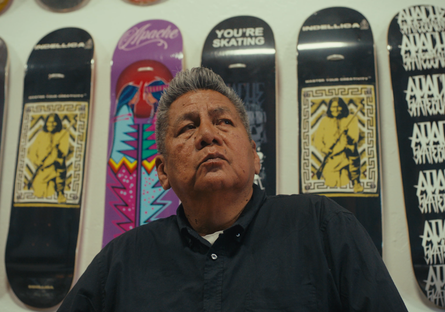
Long before the skateboards, there was a classroom at Mesa Community College (MCC). Wanting to study his passions of art and music, Douglas Miles Sr. first enrolled part-time at MCC in the 1980s. Since he worked the second shift, from 4 p.m. to midnight, he could take his daughter to school in the morning and still have time to take a class before his shift started. That schedule wasn’t easy, but it opened a door.
“When I went to MCC, I was young, and really didn’t know too much about the world other than working,” says Miles Sr. “I knew I wanted a better life, so I knew that going to college was going to help me have a better life for my wife and kids.” He later became a full-time student studying graphic design in addition to social work.
At the time, confidence wasn’t something he had a lot of. “Mesa Community College, actually, it gave me confidence. I knew I was doing something for myself to move my life forward, but it also made me realize there’s other things I can do,” Miles Sr. says.
An Apache Artist Telling Apache Stories
Growing up, Miles Sr. noticed an absence he couldn’t shake. “I’m Apache, and all my life growing up, I really didn’t see a lot of Apache art or Apache artists, except in the movies, which are usually stereotypes about the Apaches,” he shares. “You don’t see too much about Apache history, culture.”
That gap became a purpose. Miles Sr. wanted to use his art to tell an Apache story.
Today, Miles Sr. lives and works on the San Carlos Apache Nation in Arizona. He’s a muralist, painter, photographer, activist, and entrepreneur. His murals can be seen throughout the Southwest, and his art hangs in galleries. He designs clothing and is also the founder of Apache Skateboards. Miles Sr.'s designs let Apache people see themselves.
The Skateboard That Started It All
The story of Apache Skateboards begins with a father and son. When his son, Douglas Miles Jr., was younger, he got into skateboards and needed a board. Money was tight that day. “I didn't have enough money for a skateboard that day, so I got him a blank one, and I painted it,” he recalls.
Using his graphic design background, he designed the deck with an Apache warrior figure on it. The result caught more than his son’s eye. “Once other kids in the neighborhood saw my son’s boards, they all wanted one,” Miles Sr. shares.
A hand-painted board and a father’s love sparked something neither of them expected.
More Than a Brand, It’s a Movement
That demand led to something bigger—a movement that helps younger Native Americans take pride in exactly who they are. By 2002, Apache Skateboards was officially launched.
For Miles Sr., the mission was always about the kids. “I think through Apache Skateboards, I think I just wanted Native kids to feel just proud of who they are,” he says. “It’s really about the skate team that skates for Apache Skateboards. Those skateboarders are building this state to be what it is: a proud, diverse, equitable, and powerful presence in their home communities.”
He sees the ripple effect every day. “When people see that team of dedicated artists and filmmakers and skaters that work with Apache Skateboards, especially young people, young Native people, this encourages communities and encourages youth. They are the future.”
Seeing Opportunity as an Open Door
Miles Sr. has a unique way of describing possibility. For him, it’s visual.
“When I hear the word opportunity, I don’t hear it; I see it, and I visualize a door opening and a room we can walk into,” he says. “It’s a continual open door.”
That image captures his journey. A part-time education becomes a doorway. A blank skateboard became a doorway. Now, Apache Skateboards holds that door open for the next generation of Native American youth.
That’s exactly what Maricopa Community Colleges offers: opportunity. Whether a student is juggling a full-time job, family commitments, or both, the system’s 10 colleges provide them with support and resources to discover their passions. Learn more at maricopa.edu.